TECH POLICY
Data Ownership: Debates, Policy, a Blockchain-Driven Future?
Who owns your data? Big tech companies are increasingly making money off of this valuable data and it begs the question: What right, if any, do individuals have over their data?
RB
Rachel Byfleet
Content Lead
September 24, 2024
Defining Data Ownership
Who owns your data? Think location tracking, purchase patterns, search history, social media posts. Big tech companies are increasingly making money off of this valuable data. For individuals, data ownership refers to controlling access to personal data such as health records and location patterns. For organisations, it refers to managing who is eligible to access customer data while ensuring compliance with regulations. Unlike data governance, data ownership has several intricate frameworks and regulations that are crucial to stay up to date with.
Background and Current Debates
Data ownership must strike a balance between increasing data availability while ensuring individuals retain control. Some argue data ownership is critical in the digital age, others believe data should be freely accessible as a public good, and a third group argues personal data protection is about privacy rights rather than ownership. Platforms like Google and Meta collect vast amounts of data from search histories with not always full visibility for users. The EU has developed strategies like the European Digital Strategy, the Data Governance Act, and the Data Act to outline data collection perimeters and strike a balance between user control and innovation.
The GDPR and Data Ownership
The GDPR establishes rules to ensure individuals' rights regarding their personal data, enforced by the European Data Protection Board. It outlines the need for clear consent to data processing, the right to revoke data and be forgotten, and the ability to port data between service providers. For businesses, the GDPR mandates security measures, appointment of a data protection officer, and breach notification. However, the GDPR's strong data protections can conflict with the EU's efforts to foster free-flowing data as mentioned in the Data Governance Act.
The GDPR governs how the personal data of individuals in the EU may be processed and transferred and is the strongest privacy and security law in the world. -- European Commission
Government Surveillance and Data Ownership
One of the most contentious areas of data ownership is government surveillance powers versus citizens' ownership rights. The US FBI uses Network Investigative Techniques, Russia employs a SORM monitoring system, China has the Great Firewall, and Germany uses a Staatstrojaner -- surveillance software secretly installed on devices. Germany's case is illustrative: police initially used spyware to fight crime, but in 2017 the law expanded to allow reading encrypted messages. The Federal Constitutional Court later ruled it partially unconstitutional, limiting it to serious crimes like terrorism. Europe's Chaos Computer Club advocates removing the authorisation to use malware altogether.
- United States: FBI Network Investigative Techniques (NITs)
- Russia: SORM system for monitoring and malware installation
- China: Great Firewall with surveillance and censorship
- Germany: Staatstrojaner state trojan for device monitoring
Blockchain and Data Ownership
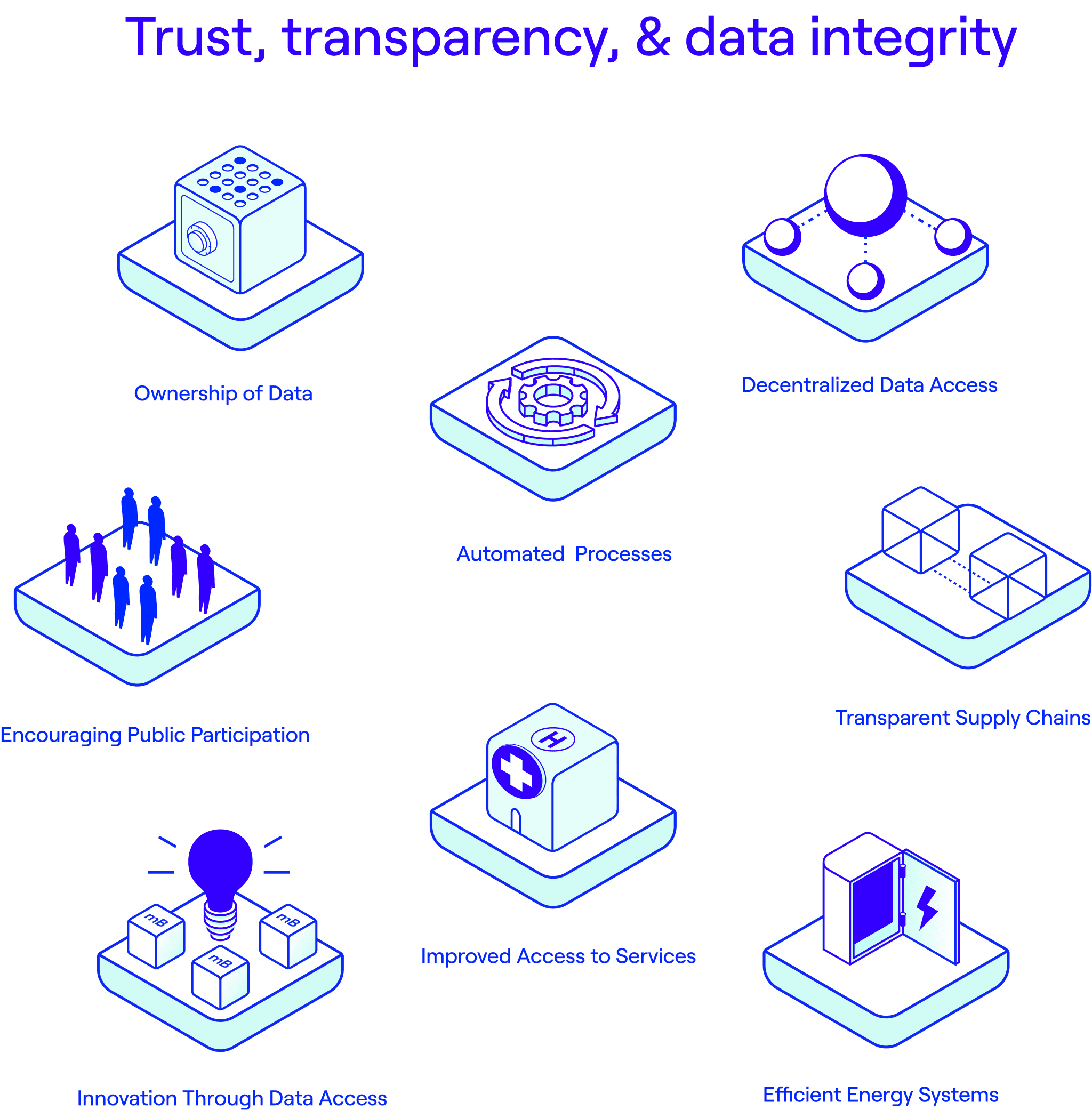
Blockchain provides a novel approach to enable effective data ownership. Rather than one organisation controlling data, blockchain offers a decentralised solution. Data stored on a blockchain is dispersed among several blocks forming an immutable chain, copied to all participants to ensure no centralised point of failure. Each user is assigned a public key (visible identifier) and a private key (access to private information). Governments are well aware of the positive implications -- the World Economic Forum highlights Malta, Belgium, and other entities already utilising this technology. The UK Government published a report highlighting blockchain's potential for collecting taxes, delivering benefits, issuing passports, recording land registries, and ensuring the integrity of government records.
Distributed ledger technologies have the potential to help governments to collect taxes, deliver benefits, issue passports, record land registries, assure the supply chain of goods and generally ensure the integrity of government records and services. -- UK Government
What's Next?
Establishing frameworks around data ownership represents an urgent need for balancing innovation and privacy. Putting individuals back in control of their data can no longer remain in question. However, making the shift necessitates broader public awareness and regulatory support. Organisations play a pivotal role -- now is the time to champion these efforts through implementing new technologies like blockchain and keeping abreast of emerging regulations. Failure to do so can cause reputational damage, compliance issues, and ultimately risks leaving companies behind.