NEWS
A New World Record! 50 Million Transactions In 24 Hours
mintBlue just set a new World Record: we pushed the largest volume of transactions (a casual 50.53 Million) in 24 hours onto the public blockchain.
NvdB
Niels van den Bergh
CEO
March 16, 2023
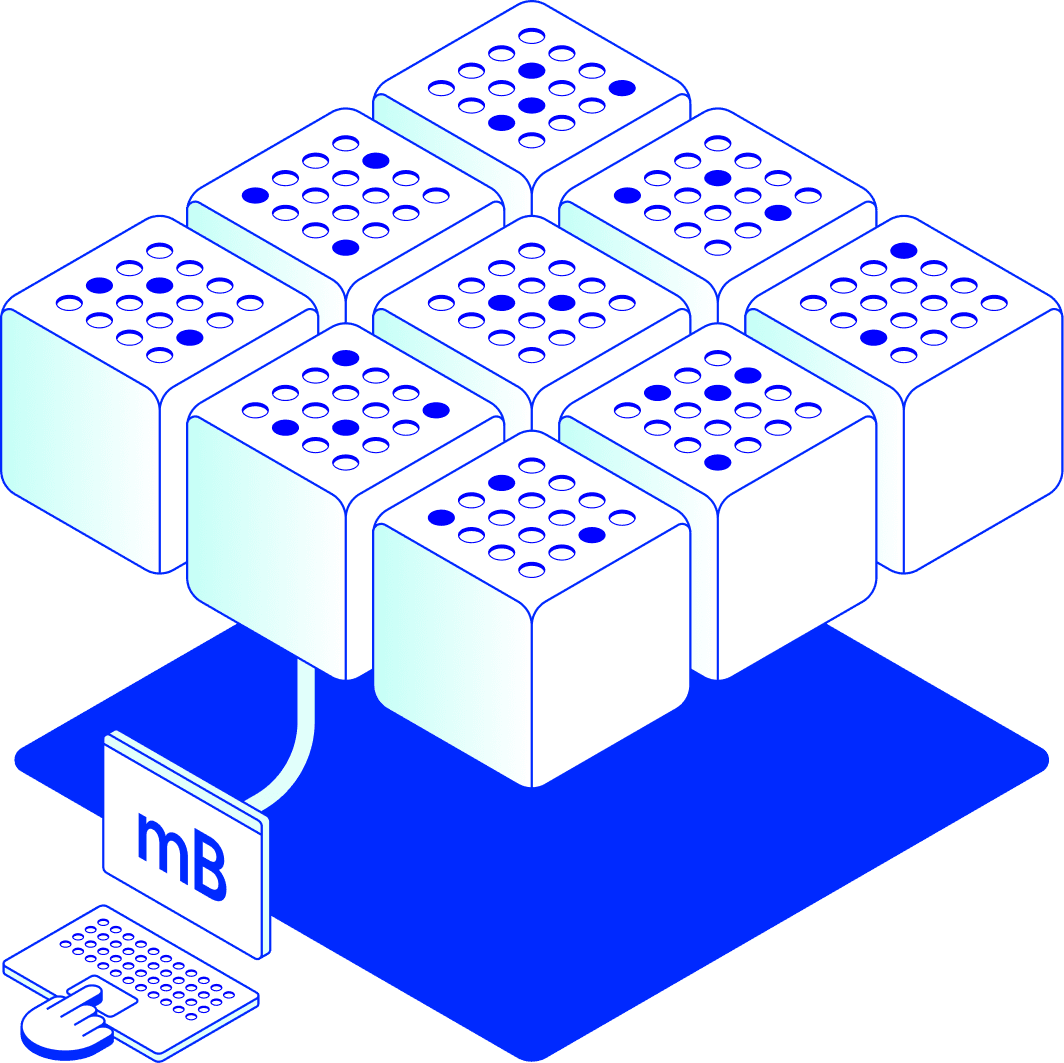
What Is The Public Blockchain?
The public blockchain is an open network, in stark contrast to a private blockchain. It is a shared database that allows anyone to privately store and exchange information without dependency on a trusted third party like Big Tech. The public blockchain protects privacy and safeguards a tamper-proof data trail, offering transparency and the possibility to verify transactions without compromising privacy. It is equipped against attacks, and data is unchangeable, making it fraud-resistant.
The World Record
During our 24-hour event on March 15, 2023, we published 50.53 million documents on-chain. This presents a definitive counterargument to the blockchain trilemma, a term popularised by Ethereum Founder Vitalik Buterin -- we proved the opposite is true. We processed 20 times more transactions than iDeal and Adyen do combined on an average day, all at a mere fraction of the cost compared to any other blockchain technology. This entire 50 million transaction experiment incurred only EUR 400 in fees.
| Metric | Result |
|---|---|
| Transactions in 24 hours | 50.53 million |
| Total cost in fees | EUR 400 |
| Comparison to iDeal + Adyen | 20x more daily volume |
| CO2 emissions | 55 metric tons (fully offset) |
| Energy vs. Bitcoin | 0.4-1.6% of BTC energy usage |
Scalability and Affordability
We throughput the highest Transactions per Second (TPS), transferred real data files with automated regulatory markup on-chain, and sustained the transaction load over 24 hours. On the business side, it proves affordability for large enterprise use cases with high data volumes. This stress test would have cost multitudes on mainstream alternatives like Ethereum and Hyperledger. The economic model of the public blockchain simply makes sense -- it's why it's dubbed the enterprise blockchain, and why failed blockchain projects rise like a Phoenix when they discover its viability.
The Public Blockchain Trifecta
We introduce The Public Blockchain Trifecta as a counterpoint to the blockchain trilemma. Permissionless Resilience: a decentralised network topology ensures greater resilience, with professional data centres competing for 99.999% uptime and any data centre able to join or leave without gatekeepers. Security: the network can be verified independently, with data centres keeping each other in check. What's unique is that security is baked into the economic model -- it's simply not economically viable to orchestrate attacks. Scale: on the public blockchain, blocks are unbounded. The large block size combined with professional data centres ensures it's built for unlimited scale.
- Permissionless Resilience: 99.999% uptime, no gatekeepers
- Security: Economic model makes attacks financially unviable
- Scale: Unbounded block size for unlimited throughput
Example Applications
What would you do if you could leverage the public blockchain at this scale? 50 million UBL invoices authenticated and transferred between bookkeepers -- inspired by our VISMA | Yuki implementation. 50 million MBs or 50 Terabytes immutably stored at a fraction of the cost of cloud storage. 50 million identities authenticated -- you could authenticate every inhabitant of Belgium and the Netherlands in half a day. 50 million coffee bags traced to their provenance, enabling impact revenue models. 50 million receipts distributed securely to accounting systems with fully integrated Point-of-Sale systems. With an enterprise implementation averaging about two hours, blockchain use cases are more accessible than ever.